Introduction
Most small print shops do not lose envelope work on price. They lose it on make-ready. By the time an offset press is plated and running, a 1,500-piece personalized job has already eaten its own margin — so the work gets turned away or sent to a trade printer.
A production inkjet envelope press changes that arithmetic. Setup takes one or two envelopes. Variable data comes straight out of the PDF. A short run stops being a favor and becomes a product.
This guide compares the four current HP iJetColor envelope presses and matches each one to the shop size it is actually built for.
Key Takeaways
- Four presses cover roughly 7,000 to 20,000 #10 envelopes per hour
- All four run with a single operator and print full-bleed with PMS color matching
- Setup in one or two envelopes is what makes short runs profitable
- The 1175 fits a workbench; the 1275 Pro needs 18 ft by 4 ft and 220V
- Only the 1175 Pro + PXG prints packaging substrates
- Match the press to monthly volume, not to peak-hour speed
How To Choose: Volume First, Speed Second
Rated hourly speed is the number everyone quotes and the wrong one to buy on. What matters is your monthly volume against the press designed for it, because that is what determines duty cycle, feeder wear and whether you spend your day standing at the machine.
Ask four questions:
- What is your realistic monthly envelope volume, today and in eighteen months?
- What formats do you run, and how thick is the heaviest piece?
- Do you need packaging substrates, or only envelopes?
- What floor space and electrical supply do you actually have?
HP iJetColor 1175 — The Compact Starting Point
The 1175 is a benchtop press and the natural entry point for a shop bringing envelope work in-house for the first time.
- Speed: up to 7,000 #10 envelopes per hour
- Feed size: up to 11.75" x 17"; maximum print area 11.7" x 17"
- Maximum feed thickness: 1/8"
- Footprint: 9 ft long by 3 ft deep, right-to-left feed
- Electrical: 110V 15A, four outlets
- Printhead: HP FI-1000 PageWide thermal inkjet
It is a 2023 production-class machine with a Quick Adjust Feeder, industry-leading alignment and a full-bleed belt system. It ships with the iJetColor Assist tablet and is offered with the iJetColor Ink-Only purchase plan alongside a comprehensive 5-year service program. Free nesting envelopes are available with the 1175.
Best for: shops adding envelope capacity without rebuilding the floor plan, where 110V and a workbench are the constraints.
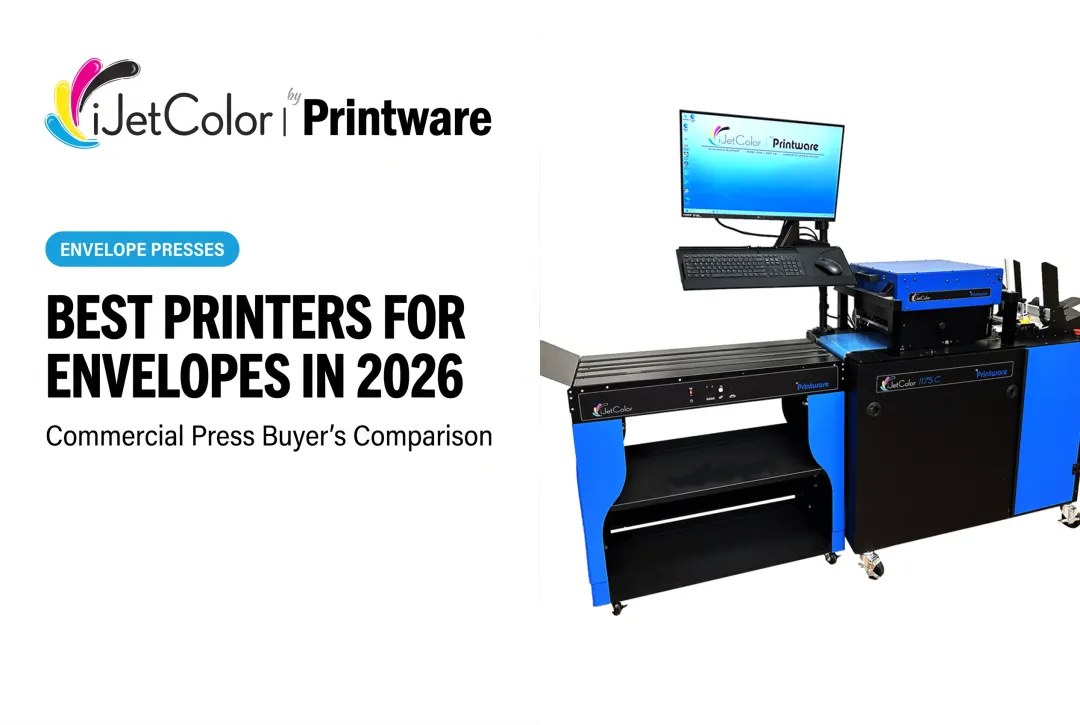
HP iJetColor 1175C — The Console Workhorse
The 1175C is described as the most affordable console-based inkjet printer in the line, combining the affordability of the 1175 benchtop with faster variable speeds.
- Speed: 6,210 to 10,000+ envelopes per hour
- Feed size: minimum 3" x 3.5", maximum 12" x 17"; maximum print width 11.7" x 17"
- Maximum feed thickness: 3/8"
- Footprint: 9 ft long by 3 ft deep, right-to-left feed
- Electrical: 110V 15A, two outlets
- Printhead: HP FI-1000 PageWide thermal inkjet
It is built for operations running 100,000+ envelopes a month, with a Quick Adjust Feeder that is automated and integrated with variable speed, a 16.8 million color matrix, and an industry-exclusive 5-year service program. The iJetColor Assist tablet is included.
Best for: established shops where envelope work is a steady revenue line rather than an occasional job.
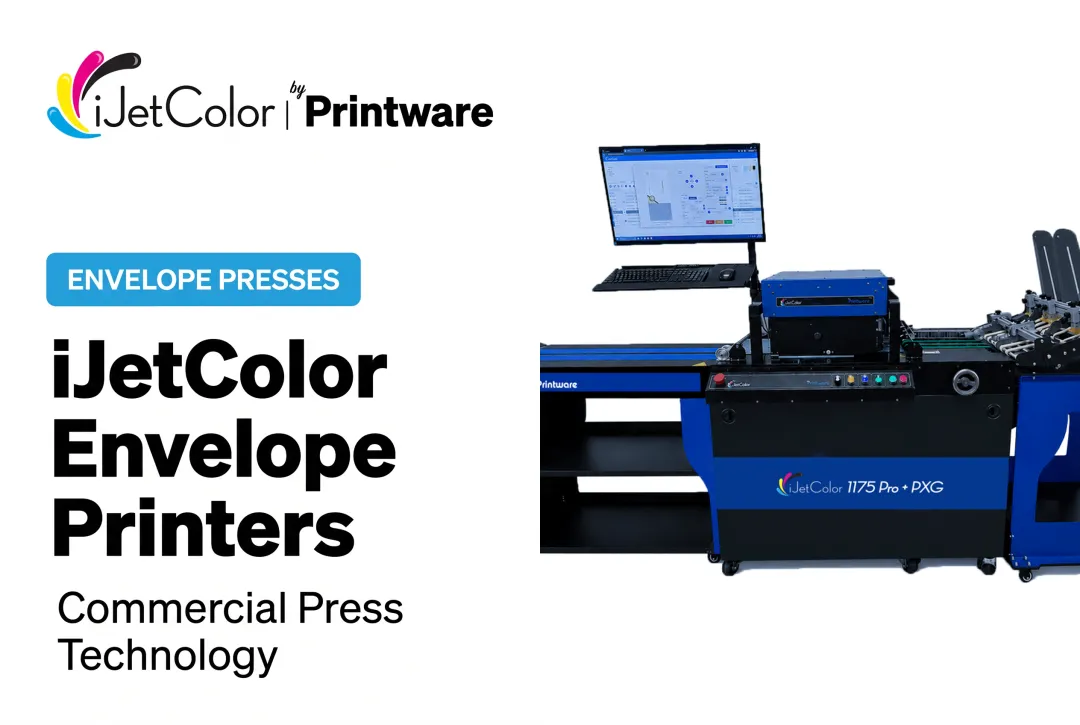
HP iJetColor 1175 Pro + PXG — When Packaging Enters The Mix
This is the versatile machine in the line, and the only one that prints packaging.
- Speed: 10,000+ envelopes per hour; packaging at 18 inches per second
- Envelope feed: minimum 2" x 3.5", maximum 12" x 17"; thickness to 3/8"
- Packaging feed: up to 14" x 20"; thickness to 1/2"
- Maximum print area: 11.7" x 17"
- Footprint: 10.5 ft long by 3 ft deep, right-to-left feed
- Electrical: 110V 15A
- Printhead: HP FI-1000 thermal inkjet
It pairs Straight Shooter automated vacuum envelope feeding with an integrated PXG feeder, and handles paper bags, small corrugate and other packaging substrates. It is built for 150,000+ envelopes a month.
Best for: shops whose customers are asking for branded short-run packaging alongside envelope work.
HP iJetColor 1275 Pro — Production Class
The flagship, and the one that changes what kind of work you can bid on.
- Speed: up to 20,000 #10 envelopes per hour
- Feed size: 12" x 14"; images every envelope size up to 12.75"; maximum print width 12.7"
- Resolution: 1200 x 1200 dpi
- Footprint: 18 ft long by 4 ft deep
- Electrical: 220V 30A plus 110V 15A
- Printhead: HP TIJ 4.0 108 mm CMYK printbar
It uses a rotary vacuum pick-up feeder holding up to 1,000 envelopes with roller-based alignment, and an 8 ft smart exit conveyor with stacker, job and output count, and double-feed detect. Ink is low-cost and geared for offset volumes. It runs with a single operator.
Best for: operations moving genuine offset envelope volume onto digital.
Side By Side
| Press | Speed (#10/hr) | Max feed | Thickness | Footprint | Power |
|---|---|---|---|---|---|
| 1175 | Up to 7,000 | 11.75" x 17" | 1/8" | 9 x 3 ft | 110V 15A |
| 1175C | 6,210–10,000+ | 12" x 17" | 3/8" | 9 x 3 ft | 110V 15A |
| 1175 Pro + PXG | 10,000+ | 12" x 17" env / 14" x 20" pkg | 3/8" / 1/2" | 10.5 x 3 ft | 110V 15A |
| 1275 Pro | Up to 20,000 | 12" x 14" | — | 18 x 4 ft | 220V 30A + 110V 15A |
What All Four Share
- HP thermal inkjet printheads with pigment-based HP ink that is water, fade and scratch resistant
- Full-bleed printing with PMS color matching from a PDF-based DFE and RIP
- Variable data support for personalized direct mail
- Single-operator running
- Setup measured in one or two envelopes
- Eligibility for iJetAdvantage service and supply coverage
iJetColor Flow 2.0 is available for all 1175 models: DFE-based RIP software plus an HP printhead firmware upgrade, adding CMYK True Color, a Print Quality Optimizer for die position and ink density, a Cost Calculator with CSV export, and job management tools. It installs remotely by TeamViewer in 10 to 15 minutes.
Conclusion
For most small shops the honest answer is the 1175 or the 1175C, chosen on monthly volume and available power rather than on headline speed. Shops with packaging demand should look at the 1175 Pro + PXG, and only operations moving real offset volume need the 1275 Pro.
The reliable way to decide is to print your own file on your own stock. iJetColor runs live demos from 2935 Waters Rd, Suite 200, St Paul, MN 55121, and provides sample kits on request. Presses are sold manufacturer-direct with equipment financing available through Synergy Financial Resources. Call (800) 456-1400 to arrange a demo.
Frequently Asked Questions
Which iJetColor press is best for a small print shop?
Most small shops start with the HP iJetColor 1175, a compact benchtop press printing up to 7,000 #10 envelopes per hour on a standard 110V 15A supply. Shops already handling 100,000+ envelopes a month usually start at the 1175C console instead.
How many envelopes per hour do these presses print?
Up to 7,000 on the 1175, 6,210 to 10,000+ on the 1175C, 10,000+ on the 1175 Pro + PXG, and up to 20,000 on the 1275 Pro.
Do I need a dedicated operator?
No. All four presses are designed to run with a single operator, and each ships with a PDF-based DFE and RIP preloaded on a dedicated CPU. The 1175, 1175C and 1175 Pro models also include the iJetColor Assist tablet.
Can these presses print packaging as well as envelopes?
Only the HP iJetColor 1175 Pro + PXG. It prints packaging up to 14" x 20" and 1/2" thick, including paper bags and small corrugate, at 18 inches per second, alongside envelope production at 10,000+ per hour.
Is short-run envelope work actually profitable on these machines?
Setup takes one or two envelopes rather than a plate change, which is what makes short runs viable. iJetColor describes digital inkjet as faster and more profitable for short-run envelope production than offset, outsourcing or toner. Confirm the economics for your own job mix with a cost analysis and a sample run.
Can the press be financed?
Yes. iJetColor sells manufacturer-direct and arranges equipment financing through its partner Synergy Financial Resources: zero payments upfront, 90-day deferred payments, and $1.00 buyout, 10% PUT or FMV options, with early payoff discounts and no blanket lien on business assets.