Introduction
Running a short-run envelope job on an offset press means plates, chemicals, and skilled operators, just to print a few thousand pieces. Toner systems are more flexible but choke on speed and cost once volume climbs.
Many commercial printers and mailing operations know this problem well: setup time eats into profit, and any request for personalized, full-color envelopes turns into a scheduling headache.
The industry has been moving away from these constraints. In a 2025 survey of in-plant print operations, PRINTING United Alliance found that printers added twice as many inkjet envelope presses as toner envelope presses over the prior two years. Digital inkjet is no longer a niche alternative. It is the equipment printers are actually buying.
iJetColor has been part of that shift, with more than 2,500 machines deployed to over 1,500 customers nationwide. This guide breaks down what inkjet envelope printers are, walks through iJetColor's full lineup, and helps you match a model to your volume and budget.
Key Takeaways
- HP thermal inkjet delivers full-color, full-bleed printing with near-zero setup waste
- iJetColor models span 7,000–20,000 envelopes/hour across benchtop, console, and industrial tiers
- Inkjet is faster and more profitable for short-run envelope production than offset, outsourcing, or toner
- Every model runs pigment-based HP ink that is water, fade, and scratch resistant
- The iJetColor Pro 1175P won 2020 PRINTING United Alliance Product of the Year in the digital press category
What Is an Inkjet Envelope Printer?
Inkjet printing fires microscopic droplets of ink through a nozzle array to build an image directly on the page. No plates, no dies, no chemistry. Every current iJetColor press uses HP thermal inkjet, in two printbar generations.
HP Thermal Inkjet Print Engines
- HP PageWide (HP FI-1000): A tiny heating element vaporizes ink inside the nozzle, creating a bubble that forces a droplet out. This is the print engine in the iJetColor 1175, 1175C, and 1175 Pro + PXG.
- HP TIJ 4.0 printbar: The same thermal principle across a 108 mm CMYK printbar at 1200 x 1200 dpi, built for the highest envelope volumes. It drives the iJetColor 1275 Pro.
Both generations solve the same problem: put ink exactly where it belongs, at speed, without a plate.

Built to Handle Flaps, Seams, and Varying Thickness
A document printer only has to move flat paper in a straight line. An envelope printer has to manage a seam down the middle, a flap that folds unevenly, and stock ranging from a lightweight #10 to a padded mailer. That's why each iJetColor press is built around a dedicated feeding and alignment system, not a printhead bolted onto a generic paper path.
The 1175 Pro + PXG uses "Straight Shooter Technology," a vacuum feed system that keeps envelopes registered through the print zone regardless of flap position. The 1275 Pro pairs a rotary vacuum pick-up feeder with roller-based alignment, loading up to 1,000 envelopes at once.
Pigment Ink Matters as Much as the Printhead
Dye-based inks are soluble and can smear or fade depending on the media. Pigment-based inks sit on the surface and resist water and abrasion better. Every iJetColor press runs pigment-based HP ink that is water, fade, and scratch resistant, so a finished piece holds its color and detail after handling.
That durability matters for mail that spends days in transit or risks a rainy mailbox.
Durable ink is only part of what makes short-run envelope work practical. Offset presses need plates and cylinders before a single sheet runs, which only makes economic sense at high volume. Inkjet skips that step entirely. On a console-based iJetColor press, changing jobs takes one or two test envelopes, not a plate change.
The iJetColor Product Lineup: Choosing the Right Model
iJetColor's lineup spans three tiers: benchtop, console, and industrial packaging press, so a two-person print shop and a national mail house can both find a machine sized to their volume.
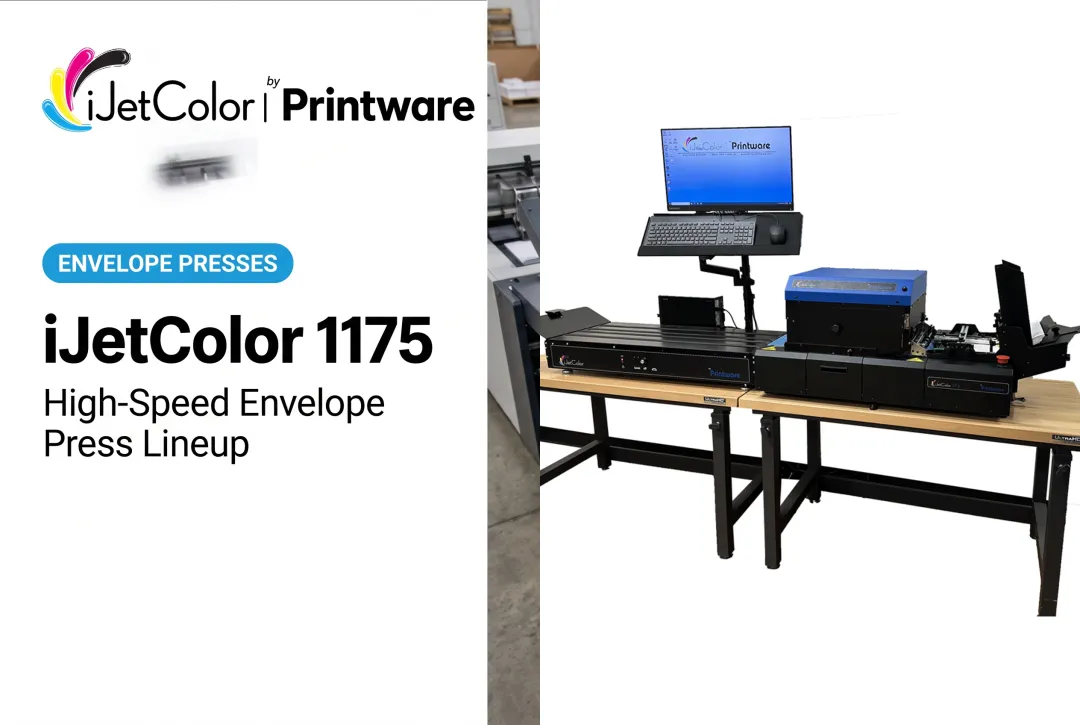
iJetColor 1175 (Benchtop)
The 1175 is the entry point: an affordable, compact system built on HP PageWide thermal inkjet and the HP FI-1000 printhead. It's designed for shops testing full-color, short-run envelope production before committing to a larger console model.
- Prints up to 7,000 #10 envelopes per hour
- Handles feed sizes up to 11.75" x 17"
- Built for short-run, full-color envelope work
- Uses the same water-, fade-, and scratch-resistant pigment ink as the rest of the lineup
iJetColor 1175 Pro + PXG
The 1175 Pro + PXG is iJetColor's most widely installed console model; as the iJetColor Pro 1175P it won the 2020 PRINTING United Alliance Product of the Year award in the digital press category. It is built for shops producing 150,000 or more envelopes monthly.
- Runs more than 10,000 envelopes per hour, and 18 ips on packaging work
- Straight Shooter vacuum feed plus an integrated PXG feeder for longer unattended runs
- Handles envelopes up to 3/8" thick and packaging substrates up to 1/2" thick, including paper bags and small corrugate
iJetColor 1175C
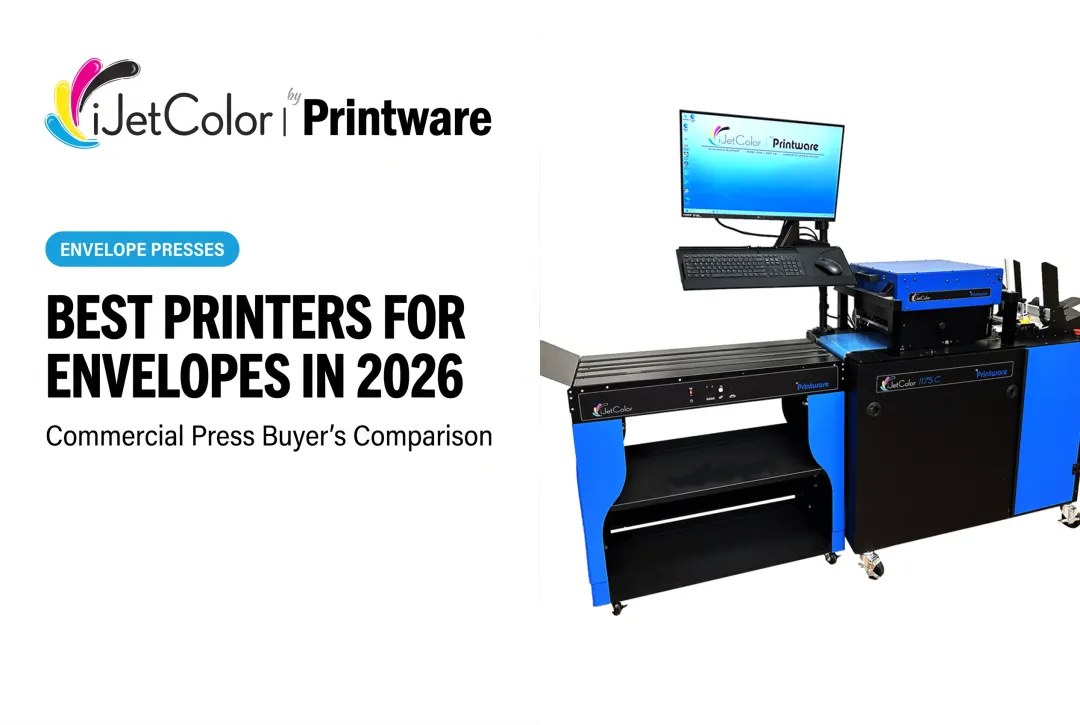
The 1175C takes the console architecture that made the Pro successful and prices it closer to the benchtop tier: an industrial system a single operator can run.
Built on the HP FI-1000 PageWide printhead, it uses a Quick Adjust Feeder and integrated alignment—no separate alignment unit required.
- Rated 6,210 to 10,000+ envelopes per hour
- Envelope sizes up to 12" x 17", up to 3/8" thick
- Recommended volume above 100,000 envelopes monthly
- Ships with the iJetColor Assist tablet and a 5-year service program
HP iJetColor 1275 Pro
For ultra-high-volume envelope work, the 1275 Pro is the industrial tier: an HP TIJ 4.0 108 mm CMYK printbar rated up to 20,000 #10 envelopes per hour—roughly double the 1175C or 1175 Pro + PXG at top speed—with a rotary vacuum pick-up feeder holding up to 1,000 envelopes.
- 1200 x 1200 dpi across a maximum 12.7" print width, imaging every envelope size up to 12.75"
- 8 ft smart exit conveyor with double-feed detect
- Low-cost ink geared for offset volumes
iJetColor Flow 2.0 (Software)
Flow 2.0 is the software tier: DFE-based RIP software plus an HP printhead firmware upgrade for all iJetColor 1175 models. It adds CMYK True Color, a Print Quality Optimizer for die position and ink density, a cost calculator with CSV export, and job management tools such as even/odd pages, reverse order, and length-based scaling. Install is remote by TeamViewer in 10–15 minutes. It is $990, or $490 with iJetAdvantage, and free to 2025-model users; the PQ Optimizer tool is free for all 1175 models.
Quick pick by monthly volume:
- Short-run and growing volume: start with the 1175 benchtop
- 100,000+: 1175C for console capability at a lower entry price
- 150,000+: 1175 Pro + PXG for unattended, high-volume envelope and packaging runs
- 20,000/hr envelope peaks: the 1275 Pro

Key Benefits & ROI of Switching to Inkjet Envelope Printing
The financial case for inkjet comes down to what you stop paying for: plates, extended makeready, and wasted stock on short runs.
Setup Time Measured in Envelopes, Not Hours
Offset requires new plates and blanket adjustments for every job change. Console-based iJetColor presses need one or two test envelopes to dial in registration and color.
Smithers research ties inkjet's short-run advantage directly to avoiding the cost and time of making plates or cylinders. That advantage shows up on the shop floor as faster job turns and less wasted stock.
Print-on-Demand and Variable Data
Because there's no plate holding a fixed image, every envelope in a run can differ. That opens the door to:
- Personalized names, addresses, and offers on direct mail
- Sequential numbering for security or tracking purposes
- Full-bleed, four-color graphics without a separate hit for variable text
Shops that make the switch typically find a small increase in ink cost is outweighed by eliminating offset-related expenses entirely. Running setups of just one or two envelopes cuts waste substantially.
Better Short-Run Economics
For short-run envelope production, inkjet is faster and more profitable than offset, outsourcing, or toner. Actual results vary with utilization and pricing, and financing through Synergy Financial Resources can start with zero payments upfront and 90-day deferred payments. Every job that used to leave the building for offset printing now generates margin in-house instead.
Bringing Outsourced Work Back In-House
Capacity matters here. The 1175 Pro + PXG supports monthly output above 150,000 envelopes, enough for most shops to absorb jobs they previously farmed out. Shops that add a console press when a toner machine can no longer keep up with short-run demand bring that work back inside, and it shows up on the bottom line directly.
How to Choose the Best Envelope Printer for Your Business
Picking the right press starts with honest numbers, not the fastest machine on the spec sheet.
Match the Model to Your Actual Volume
- Under 50,000 envelopes/month: A benchtop system like the 1175 covers short-run, full-color work without over-buying capacity you won't use.
- 100,000+ envelopes/month: Console models like the 1175C or 1175 Pro + PXG are built for sustained, single-operator production.
- 20,000 envelopes/hour or packaging formats: The 1275 Pro fits high-volume mail houses; the 1175 Pro + PXG handles packaging runs.
Buy more capacity than your volume justifies and you tie up capital. Buy less and you hit bottlenecks the moment demand grows.
Check Ink Durability, Not Just Color Quality
If envelopes travel through the mail stream, get handled repeatedly, or risk moisture exposure, the ink chemistry matters. Look for pigment-based ink rather than dye—every iJetColor press runs pigment-based HP ink that is water, fade, and scratch resistant. Don't take a generic "water-resistant" claim on faith.

Prioritize Manufacturer-Direct Support
Downtime on a press running 150,000 envelopes a month gets expensive fast. Require manufacturer-direct support: dedicated service engineers, live response within the hour during business hours, and next-day parts under an active contract. iJetColor's iJetAdvantage service and supply agreement is built around those terms—24/7 free phone technical support at (800) 456-1400 ext 2, plus next-day replacement printheads and spare parts—without routing you through a third-party reseller.
Industries That Rely on Inkjet Envelope Printing
Inkjet envelope presses fit shops and in-plants where short-run flexibility and speed both matter.
Commercial Print Franchises and Mailing Providers
Franchise networks compete on turnaround and price, so inkjet's low setup cost is a natural fit. iJetColor customers in this segment include:
- Franchise and independent quick-print locations running short-run, full-color envelope work
- Online trade printers that fulfill mixed jobs without offset makeready
Government, Education, and Election Printing
Institutional mail has to be accurate, secure, and often produced under a hard deadline. Election printers use iJetColor console presses to produce absentee ballot envelopes, switching sizes and quantities quickly under tight deadlines.
University mailrooms and other institutional in-plants run the same class of system for membership and enrollment mailings.
Corporate In-House Print and Fulfillment
Insurance companies, e-commerce fulfillment centers, and other high-volume mailers increasingly print envelopes in-house instead of sending every job out. An in-plant team can run tens of thousands of images on a single iJetColor console press and gain the design flexibility customers notice on the finished piece.
Frequently Asked Questions
What is the best printer for printing envelopes?
The best printer depends on your monthly volume, budget, and quality requirements. For shops needing full-color, short-run flexibility, inkjet console presses like the iJetColor 1175 Pro + PXG or 1175C are a common recommendation.
What is an inkjet printer?
An inkjet printer is a digital device that fires microscopic ink droplets through nozzles to build an image directly on a substrate. There are no plates or dies involved, which is what makes on-demand, job-to-job printing possible.
How much does an inkjet envelope printer cost?
Pricing varies significantly by tier, from entry-level benchtop units to industrial packaging presses, and quotes are typically provided on request rather than published. Factor in cost per piece, support, and financing terms, not just the sticker price.
What is the difference between inkjet and offset printing for envelopes?
Offset uses plates and cylinders, which makes it efficient at very high volumes but expensive to set up for short runs. Inkjet skips the plate entirely, printing directly and on-demand, which favors short runs and variable data.
How fast can inkjet envelope printers print?
Speeds vary by model. The entry-level iJetColor 1175 runs up to 7,000 envelopes per hour, the 1175C and 1175 Pro + PXG reach past 10,000, and the industrial HP iJetColor 1275 Pro tops out at 20,000 #10 envelopes per hour.
Can inkjet envelope printers handle variable data and personalization?
Yes. Because there's no fixed plate image, inkjet presses can print a different name, address, or graphic on every envelope without slowing production or adding job cost.