That's the divide between offset and inkjet, the two technologies most commercial printers depend on today.
Picking the wrong one isn't a minor inconvenience. It shows up in your cost-per-piece, your turnaround time, and whether you can even compete for short-run or personalized jobs. A NAPCO Research survey of 219 commercial printers and in-plants found that 54% already operate production inkjet equipment, with another 23% of nonoperators planning an investment. This article breaks down how each technology works, where each one wins, and how to decide which fits your shop.
Key Takeaways
- Offset delivers the best unit cost and color consistency at high volumes—after plates and makeready are covered
- Inkjet eliminates plates entirely, making short runs, fast changeovers, and personalized print jobs far more profitable
- The "crossover point" hinges on run length, personalization needs, and turnaround pressure, not a fixed number
- Many shops run both: inkjet for short-run and variable-data work, offset for large static jobs
Inkjet vs Offset: Quick Comparison
Here's how the two technologies stack up on the factors that affect your bottom line.
Cost Structure
Offset carries a steep upfront cost: plates, press makeready, and setup time all have to be paid before a single good sheet rolls off. That cost gets absorbed as volume climbs, which is why offset per-unit pricing drops sharply at scale.
Inkjet flips the model. There are no plates to burn and almost no setup cost, so:
- Cost-per-piece stays relatively flat whether you print 500 pieces or 50,000
- Short runs that would be unprofitable on offset become viable
- Small jobs no longer require a large minimum order to justify the press time
Print Quality & Color Consistency
Offset still holds the edge for exact custom color matching, particularly with Pantone spot inks and fine detail work. It's the standard brand teams reach for when color fidelity can't be negotiated.
That said, the gap has narrowed. Pigment-based inkjet systems, including HP PageWide and HP TIJ 4.0 thermal inkjet platforms, now produce sharp text, clean graphics, and vibrant full-bleed color that competes with offset on most commercial jobs.
Turnaround & Setup Time
Turnaround is inkjet's clearest advantage. Offset plate-making and press makeready can add hours—sometimes days—before a job starts running.
Inkjet presses like the iJetColor 1175 Pro + PXG need as few as 1-2 test envelopes to dial in a new job, so operators can move from one job to the next almost immediately.
Personalization & Variable Data
Offset runs one static image per plate set. Change the content mid-run, and you're stopping the press. Inkjet handles variable content without slowing down:
- Names, addresses, and unique codes can change on every single piece
- No press stoppage or re-plating required between variations
- Ideal for personalized direct mail, transactional documents, and packaging that needs unique identifiers

What Is Offset Printing?
Offset lithography is an indirect printing process. Ink is applied to an aluminum plate, transferred to a rubber "blanket," then rolled onto the paper. That indirect transfer is why offset produces such consistent image quality run after run, according to the EPA's technical description of the process.
That mechanical consistency translates into operational advantages:
- Lower cost-per-unit at scale, since plate costs spread across large quantities
- Wide substrate compatibility, from coated stock to specialty papers
- High color fidelity, especially for brand-critical work requiring exact Pantone matches
Sheetfed vs. Web Offset
Offset comes in two main flavors. Sheetfed offset handles shorter, higher-quality jobs one sheet at a time and suits work needing precise trim and finishing. Web offset feeds from a continuous roll and is built for volume, powering newspapers, magazines, and high-circulation publications.
The tradeoff is unavoidable: offset requires real makeready time and cost. That's fine when you're running hundreds of thousands of pieces. It's a poor fit for a 2,000-piece job that needs to ship tomorrow.
Use Cases of Offset Printing
Offset earns its place in production workflows built around volume and precision:
- Large-run catalogs and magazines where thousands of identical pages need consistent color
- Newspapers and other high-volume periodicals printed on web presses
- Packaging brands that require exact Pantone matches for logo colors
- Direct mail campaigns large enough to absorb plate and makeready costs
Historically, industry commentary pointed to somewhere around 4,000 to 5,000 comparable images as a rough point where offset started beating digital on cost. But WhatTheyThink's 2023 analysis pushes back on treating that as gospel. Format, ink coverage, paper stock, color count, and finishing requirements all shift where that line actually falls for a specific shop and job.
What Is Inkjet Printing?
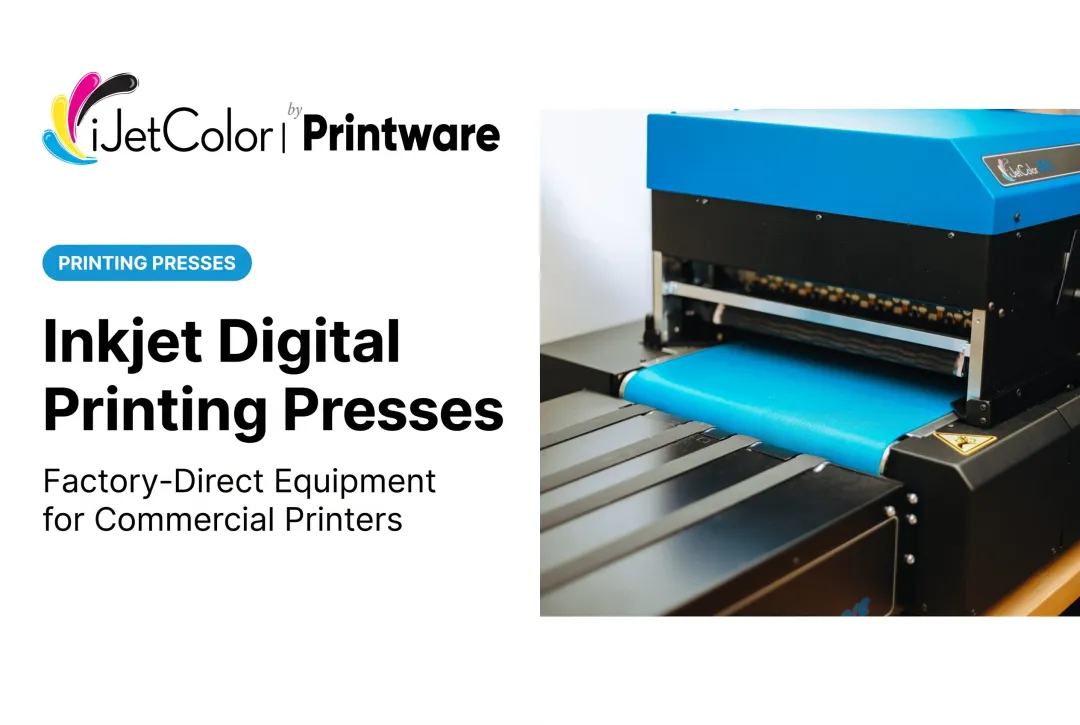
Inkjet is a digital process. It sprays liquid ink directly onto a substrate, no plates required. That single difference reshapes everything about how a print shop can operate.
Without plates, there's essentially no setup waste. That opens the door to bringing outsourced short-run work back in-house and delivers clear speed gains over toner-based digital presses.
iJetColor describes its own presses in the same terms: faster and more profitable for short-run envelope production than offset, outsourcing, or toner.
Inkjet Technology Families
Not all inkjet is built the same way:
- Thermal inkjet (TIJ), used by HP, heats ink to eject drops through printhead nozzles
- Piezo drop-on-demand (DOD), which uses pressure changes to fire ink and recirculates it to prevent nozzle clogging
- Continuous inkjet (CIJ), which generates a steady stream of drops rather than firing on demand

Purpose-Built for Envelopes and Packaging
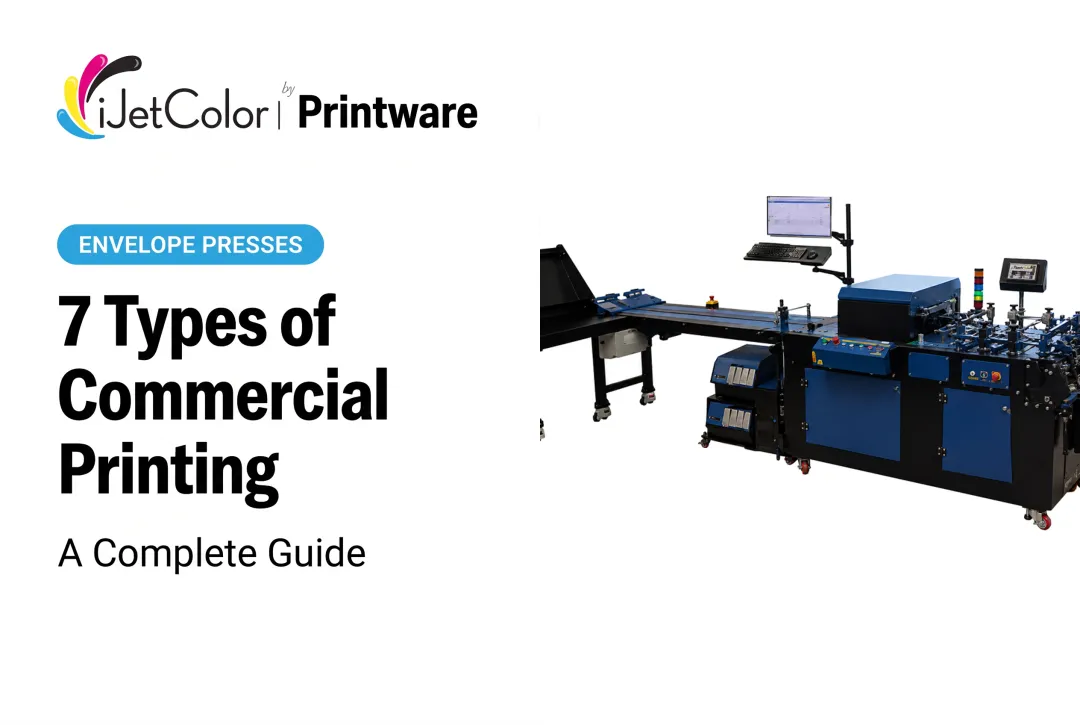
Commercial inkjet is especially strong on envelopes and packaging, where short runs and variable data are the norm. iJetColor by Printware builds its press lineup around those jobs. The 1175, 1175C and 1175 Pro + PXG use HP PageWide technology with the HP FI-1000 printhead, while the 1275 Pro runs HP's newer TIJ 4.0 printbar. Depending on the model, speeds range from up to 7,000 #10 envelopes per hour on the compact 1175 up to 20,000 #10 envelopes per hour on the 1275 Pro.
The inks matter as much as the hardware. Every iJetColor press runs pigment-based HP ink that is water, fade, and scratch resistant. That durability matters for mail pieces and packaging that get handled, rained on, or shipped.
Use Cases of Inkjet Printing
Inkjet dominates where volume is unpredictable or personalization is required:
- Short-to-medium run direct mail where every piece needs a unique name or offer code
- Transactional printing, such as statements and invoices
- Packaging prototypes and short packaging runs before committing to a larger offset order
- In-house corporate print operations at insurance companies, universities, and government agencies handling diverse, lower-volume jobs
Engage Print in Northfield, Minnesota offers a clear illustration. As Dan Neuger put it, “up until this press was available, we couldn't find anything that could handle the volume” — including the variable-data and full-color envelope work the shop previously couldn't run profitably.
Inkjet vs Offset: Which Is Right for You?
There's no universal winner here. The right answer depends on how you weigh a handful of specific factors:
- Average run length — Are you printing hundreds or hundreds of thousands per job?
- Personalization needs — Does the job require variable names, addresses, or codes?
- In-house vs. outsourced goals — Are you trying to stop sending work to outside vendors?
- Equipment budget — Can you absorb offset's upfront plate and press costs, or does inkjet's lower barrier make more sense?
- Turnaround expectations — Does the client need it tomorrow, or is a longer production window acceptable?
If you're consistently running large volumes of one static design with tight color-matching requirements, offset still wins on unit cost. If your run lengths are short-to-medium, your job mix changes constantly, or personalization is part of the ask, inkjet is the clear choice.
Plenty of shops don't pick one. They keep offset for their highest-volume, static work and add inkjet capacity for the short-run and variable jobs that offset makes uneconomical.
Shops that keep both typically shift their two-color and short-run envelope jobs off the offset press onto an iJetColor system, cutting ink-mixing time and manpower on work that never needed offset's scale.
Real-World Example: Moving Short-Run Work to Inkjet
Here's a scenario that plays out constantly in commercial print shops: a client needs 3,000 envelopes by Friday. The shop's offset press isn't economical below tens of thousands of units, so the job either gets outsourced or turned down entirely. Either way, revenue walks out the door.
SumnerOne hit exactly this problem. Demand for short-run envelope work had outgrown its slower toner-based machine, and the shop went with the console-based iJetColor 1175C, choosing it for “the speed and overall configuration.” At 6,210 to 10,000+ envelopes per hour, that class of press brings short runs in-house instead of out to a vendor.
When evaluating a similar move, look for:
- Cost per piece on your own job mix — iJetColor positions inkjet as faster and more profitable for short-run envelope production than offset, outsourcing, or toner
- Throughput matched to monthly volume — 100,000+ envelopes a month on the 1175C, 150,000+ on the 1175 Pro + PXG
- Support terms — manufacturer-direct coverage through iJetAdvantage, with 24/7 phone technical support and next-day printheads and spare parts

For shops routinely turning away or outsourcing short runs, the math usually favors adding inkjet capacity rather than forcing that work through an offset press it was never designed to handle economically.
Conclusion
Neither technology wins every job. Offset remains the stronger economic choice for high-volume, static, color-critical work. Inkjet wins on short runs, fast turnarounds, and jobs that need personalization or variable data.
Match your print volume and job mix to the right process—or run both. That choice drives cost-per-piece, waste, and how profitably your shop can compete for the full range of client work coming through the door.
Frequently Asked Questions
What is offset printing best for?
Offset is best for large-volume, color-critical, static-design jobs like catalogs, magazines, and brand marketing materials where per-unit cost drops significantly at scale.
What is inkjet printing best for?
Inkjet excels at short-to-medium runs, fast job changeovers, and any application requiring variable data or personalization, such as direct mail and transactional printing.
Which is cheaper: inkjet or offset printing?
Inkjet is more cost-effective for shorter runs since there's no plate or setup cost. Offset becomes cheaper per unit once volume crosses a high enough threshold to absorb its makeready costs.
Can inkjet printing match offset print quality?
Modern pigment-based inkjet technologies, like HP PageWide, have closed much of the historical quality gap. Offset still leads for exact custom Pantone color matching, but the difference is narrowing fast.
How do I decide between inkjet and offset for my print shop?
Weigh run length, personalization needs, and equipment budget first. Many shops end up running both, using offset for high-volume static jobs and inkjet for everything else.
Is inkjet printing more environmentally friendly than offset?
Inkjet produces less waste by skipping plates and minimizing makeready. Skipping plates also removes the chemistry, aluminium and makeready waste that plate production and press setup consume on short runs.