Many businesses default to whatever printer sits in the supply closet. That works fine for a dozen envelopes. Push past that, and you'll see jams, blotchy addresses, or ink costs that quietly eat your margin.
This guide breaks down exact C4 dimensions, where businesses actually use this format, how the major printing methods stack up, and what separates a hobby-grade printer from equipment built for commercial C4 volume.
Key Takeaways
- C4 measures 229 x 324 mm (about 9 × 12.75 in) and holds a full A4 sheet unfolded
- Desktop inkjet and laser AIOs hit paper-path and feed-tray limits as C4 volume climbs
- High-speed digital inkjet presses deliver speed, full-color quality, and low cost-per-piece at business scale
- Full-bleed printing, variable data, and durable pigment inks set professional equipment apart from office printers
What Is a C4 Envelope? Size, Specs, and Standard Uses
A C4 envelope measures 229 x 324 mm (about 9.02 x 12.76 inches). The dimensions come from ISO 269, the international standard for correspondence envelope sizes. C-series formats are built to work with ISO 216 paper sizes, the same standard that defines A4.
In practice, a C4 envelope holds an A4 sheet flat, without folding.
C4 vs. C5 vs. C6/DL: Which Size Do You Need?
If you're not sure C4 is the right call, here's how the ISO 269 sizes compare:
- C4 (229 x 324 mm): Holds an A4 sheet unfolded: contracts, certificates, multi-page reports
- C5 (162 x 229 mm): Holds an A4 sheet folded in half: standard business letters
- C6 (114 x 162 mm): Holds an A4 sheet folded twice: compact correspondence
- DL (110 x 220 mm): Common business envelope for tri-folded letters

C4 is a fixture in European correspondence and shows up regularly in U.S. operations handling international mail, legal filings, or oversized inserts that shouldn't be creased. Whatever stock you run, light text or heavier cover-weight, your press still has to feed and print it cleanly, batch after batch.
Why Businesses Choose C4 Envelopes for Mailing
Folding a document changes how it reads. A contract with crease marks looks less finished. A multi-page marketing piece loses its layout the moment it's folded into thirds.
C4's larger format keeps documents flat and presentable, which is why certain industries default to it.
Real-world C4 users include:
- Insurance carriers mailing policy documents and renewal packets that need to arrive uncreased
- Higher education institutions sending admissions materials, transcripts, and financial aid packages
- Government and election offices distributing absentee ballots and official correspondence
Michigan Election Resources in Kalamazoo runs an iJetColor envelope press to produce millions of absentee ballots, and values the ability to shift between envelope sizes, quantities and formats without slowing production.
Format choice isn't only cosmetic; it affects response. The ANA's 2021 direct mail survey found that prospecting letter-sized envelopes returned 112% ROI, with dimensional and oversized formats each still clearing 90% ROI. Larger formats don't automatically outperform standard ones, but they hold their own. That's why unfolded, full-presentation mail remains a deliberate choice for document-heavy industries.
C4 Envelope Printing Methods: Which Approach Works Best for Your Volume?
Ask "which printer is best for envelope printing" and the honest answer is: it depends entirely on your volume and color needs. Here's how the four main approaches actually compare.
Desktop and Home All-in-One Printers
Most consumer inkjet and laser AIOs are built around Letter and A4 sheet handling. C4's larger dimensions push past what their curved paper paths and feed trays were designed for. Fine for a handful of envelopes; unreliable once you're running batches on any regular basis.
Laser/Toner Digital Presses
Toner has real advantages: speed and sharp text among them. The problem is the fusing process. Toner adheres through a mix of mechanical and chemical bonding, and that bond depends heavily on the paper's surface energy and how well the toner resin wets it.
Coated or textured envelope stock doesn't always cooperate, and heat-fusing can warp or crack it. Full-color toner runs also get expensive fast on a per-piece basis.
Offset Printing
Offset still wins on very large, static runs: same design, same copy, tens of thousands of pieces. But it comes with real front-end costs: plates, makeready, calibration. That overhead makes offset a poor fit for short runs or anything involving variable data, since every version change means new plates.
High-Speed Commercial Inkjet Presses
This is the category built specifically for the job most businesses actually need done: variable, full-color, high-volume C4 mailing without offset's setup burden or toner's stock limitations. The next two sections cover what separates a real commercial solution from a printer that just happens to accept larger paper.

Key Features to Look for in a Commercial C4 Envelope Printing Solution
Not every printer marketed for "envelopes" can actually handle C4 at business volume. Here's what to check before you buy.
Paper path and printhead clearance. C4 stock is larger and often thicker than standard letter mail, and window envelopes add another variable. Look for real printhead clearance (iJetColor presses feed envelope stock up to 3/8 inch thick, and up to 1/2 inch for packaging on the 1175 Pro + PXG) and a straight paper path that avoids jams on longer runs.
Full-bleed printing. If your design needs color or graphics running to all four edges of the envelope, confirm the press actually supports 4-edge bleed. Not every "full color" printer does.
Ink durability. Mail gets handled hard: sorted, scanned, occasionally rained on. Look for pigment-based inks that resist water, fading, and scratching, rather than dye inks that smear the first time a piece meets moisture or a sorter belt. Durable pigment ink is what keeps addresses scannable and artwork clean after the mail leaves your dock.
Variable data printing (VDP). For personalized names, addresses, or offers, your RIP software needs to merge variable fields at full production speed, not as an afterthought that slows the line.
Real throughput numbers. Ask for envelopes-per-hour and sustainable monthly duty cycle , not a "pages per minute" spec lifted from an office printer datasheet. Those numbers don't translate to envelope production.
Setup and makeready time. Check how many test pieces a job changeover actually requires:
- Some commercial inkjet presses need just 1-2 test envelopes between jobs
- Offset requires plate changes and calibration that can eat hours
- Toner systems fall somewhere in between, depending on the job
Fast changeover is what makes short-run C4 jobs profitable instead of a break-even exercise.
Why High-Speed Inkjet Is the Best Printer for C4 Envelope Printing at Scale
For the short-to-medium, full-color, often-personalized C4 runs that most commercial printers handle day to day, high-speed inkjet beats both offset and toner on cost-per-piece and speed. No plates to make, no fusing to warp coated stock, no per-click toner pricing that punishes color coverage.
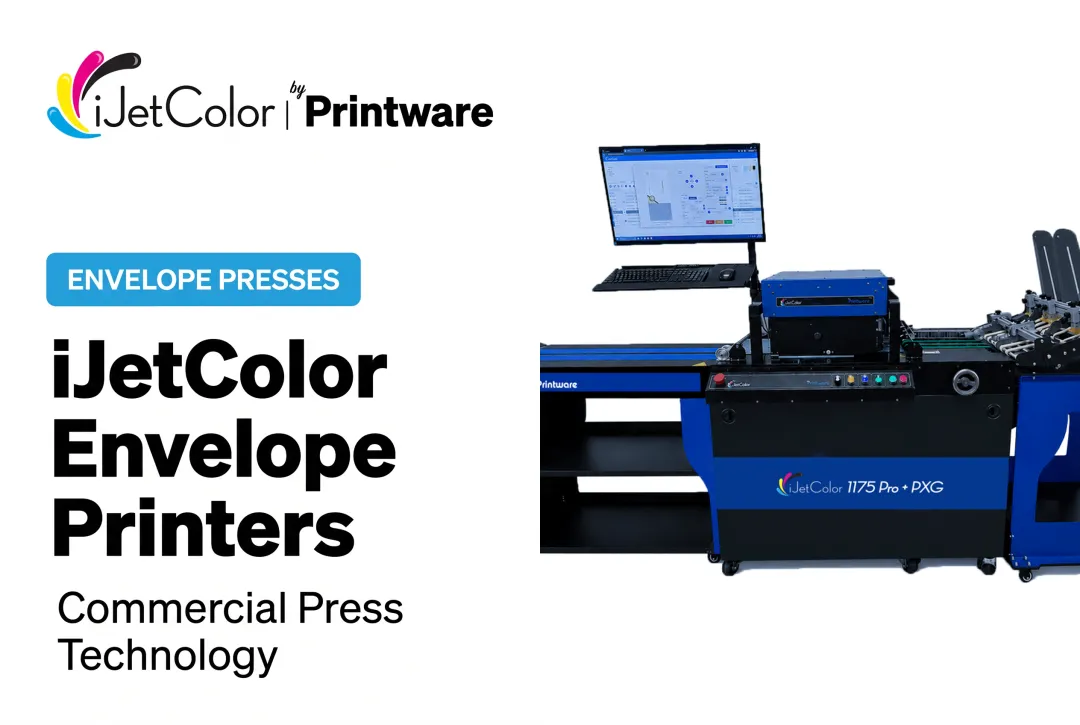
iJetColor by Printware builds its presses around this exact use case. The iJetColor 1175, 1175 Pro + PXG, and 1175C run on HP PageWide thermal inkjet technology with the HP FI-1000 printhead, paired with pigment-based HP ink that is water, fade, and scratch resistant.
What that translates to on the floor:
- Clearance for envelope stock up to 3/8 inch thick, and packaging substrates up to 1/2 inch on the 1175 Pro + PXG
- Full 4-edge bleed printing across the line
- Speeds ranging from up to 7,000 #10 envelopes per hour on the 1175 up to 10,000+ on the 1175 Pro + PXG
- Monthly production capacity of 150,000+ envelopes on the 1175 Pro + PXG

For shops replacing offset or toner lines, the economics come from minimal makeready (often just 1-2 test envelopes), lower prepress costs, and reduced per-piece production expense.
iJetColor positions the presses as faster and more profitable for short-run envelope production than offset, outsourcing, or toner.
Support matters as much as speed on the floor. Buying production equipment from a retail printer brand usually means limited help once the sale is done.
iJetColor's MFG Direct Support model connects customers with dedicated service engineers, not a third-party call center. That difference shows when a press goes down mid-run and every hour of downtime has a real dollar cost.
Frequently Asked Questions
What size is a C4 envelope?
C4 measures 229 x 324 mm (9.02 x 12.76 in) under ISO 269. It's built to hold a full A4 sheet flat, without any folding.
Which printer is best for envelope printing?
For occasional, low-volume use, a wireless inkjet or laser AIO with a straight paper path can work. For business-volume, full-color C4 printing, a high-speed commercial inkjet press like iJetColor delivers better speed, quality, and cost-per-piece.
What is the difference between C4 and C5 envelopes?
C5 fits an A4 sheet folded once in half, measuring 162 x 229 mm. C4 fits the same A4 sheet flat and unfolded, at 229 x 324 mm.
Can C4 envelopes be printed with variable data for mail merge?
Yes. Commercial digital inkjet presses support variable data printing, letting you personalize names, addresses, and messaging without slowing production speed.
How fast can commercial inkjet presses print C4 envelopes?
Commercial inkjet presses run in the thousands of envelopes per hour. iJetColor models range from up to 7,000 per hour on the 1175 to over 10,000 per hour on the 1175 Pro + PXG, far above typical desktop printer speeds.
Is inkjet or laser better for full-color C4 envelope printing?
Inkjet has the edge for full-color, photo-quality graphics and personalized variable data. Laser/toner handles high-speed monochrome text well but risks heat damage on coated or textured envelope stock.