Pick the wrong method, and you'll overpay for a short run, wait weeks for a job that should've taken days, or end up with print quality that doesn't match the file you approved. Businesses still lean heavily on physical print for a reason. USPS-commissioned research from Temple University found that physical ads produced stronger memory retention, emotional response, and lasting impact than digital ads — digital only outperformed on immediate, focused attention.
This guide breaks down the seven major types of commercial printing, how they differ, and how to match the right one to your next job.
Key Takeaways
- Commercial printing spans multiple distinct processes, each suited to different volumes, budgets, and materials
- Seven core types cover most commercial work: offset, digital, screen, flexographic, large-format, web, and gravure
- High-speed inkjet now makes short-run and personalized jobs far more affordable
- Choose by run length, turnaround, substrate, and customization needs — not by popularity
What Is Commercial Printing?
Commercial printing is the large-scale, professional production of printed materials for business use. It relies on equipment and processes that go well beyond a standard office or desktop printer.
The U.S. Census Bureau's NAICS classification for commercial printing (323111) covers lithographic, gravure, flexographic, letterpress, engraving, and digital processes, including job-order work like stationery, invitations, and labels. The definition explicitly includes quick printers and shops running digital equipment. Purpose—not shop size—determines whether a job counts as commercial printing.
You'll find it behind:
- Marketing collateral (brochures, catalogs, business cards)
- Packaging and labels
- Books, magazines, and publications
- Direct mail and envelopes
- Signage and large-format displays
Commercial printing spans multiple technologies. The best process depends on run length, substrate, color needs, and turnaround—not a single default method.
Why Does the Right Printing Method Matter?
Matching the correct printing type to a job affects three things directly: cost-per-piece, turnaround time, and final quality. Get the match wrong, and all three suffer.
Here's what typically goes sideways when a job lands on the wrong press:
- Overpaying on short runs: running 2,000 pieces on offset means eating plate and setup costs that never get spread thin enough to pay off
- Mismatched quality: using a low-resolution process for fine detail work, or an expensive high-detail process for something that didn't need it
- Missed deadlines: offset and flexo require setup and makeready time that simply doesn't work for a rush job
The sections below break down what each process does well and where it falls short.
Types of Commercial Printing
Different jobs call for different presses, materials, and setups. Here's how the seven major types stack up.
Offset (Litho) Printing
Offset lithography transfers ink from a plate to a rubber blanket, then from that blanket onto the substrate. The indirect transfer produces sharp, consistent color across long print runs.
Offset shines on high-volume runs: catalogs, magazines, books, and large marketing campaigns. Per-unit cost drops significantly as volume climbs, since fixed setup costs get spread across more pieces.
The trade-off: plate-making and setup costs are high upfront. Industry analysis from Smithers confirms that shorter runs are consistently cheaper on digital presses, while offset only wins out at longer run lengths (Smithers, 2025).
Frequent design changes make offset even less practical.
Digital Printing
Digital printing sends a file straight to the substrate (no plates, no blanket). It relies on inkjet or toner-based technology, and it's built for speed and flexibility.
Digital is the natural fit for:
- Short-to-medium runs
- Quick-turnaround jobs
- Personalized or variable-data printing (direct mail, business cards, envelopes)
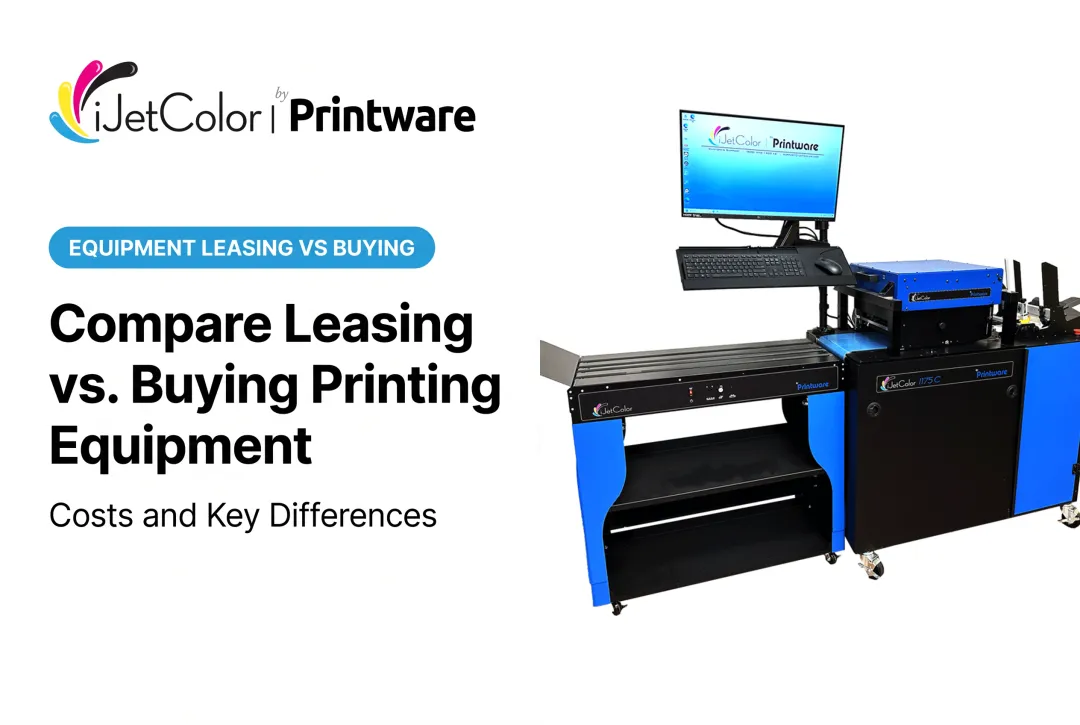
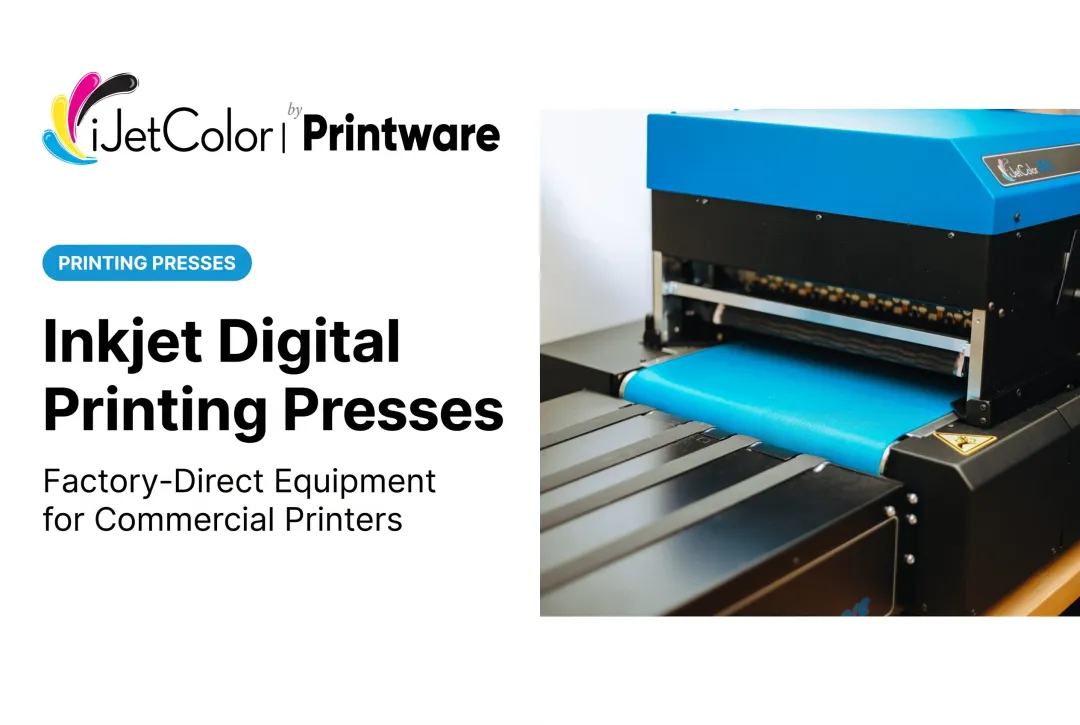
Modern high-speed production inkjet has changed the economics. iJetColor's presses run at 7,000 to over 20,000 envelopes per hour — from the HP PageWide-based 1175 to the HP TIJ 4.0-based 1275 Pro — so commercial printers can bring previously outsourced envelope and packaging runs in-house.
The 1175 Pro + PXG handles envelopes up to 3/8" thick and packaging up to 1/2", covering bubble mailers, padded envelopes, paper bags, and light corrugate alongside standard mail pieces. iJetColor positions this output as faster and more profitable for short-run envelope production than offset, outsourcing, or toner, with makeready waste of just one or two envelopes.
One Minuteman Press location in Ewing, New Jersey, reported printing four-color envelopes with variable data in-house after adding an iJet press, instead of sending that work out.

The trade-off: while digital quality now rivals offset in most applications, extremely high-volume long runs can still cost more per piece than offset.
Screen Printing
Screen printing pushes ink through a mesh stencil onto the printing surface using a squeegee. Each mesh handles one color, and non-image areas stay blocked.
It's the go-to process for:
- Apparel and textiles
- Promotional items
- Signage on unusual substrates such as glass, plastic, metal, and wood
Because screen printing lays down thick, opaque, durable ink, it holds up on materials that other processes struggle with. FESPA notes verified applications ranging from T-shirts to control-panel overlays and even solar panels.
The trade-off: labor-intensive setup makes small quantities expensive. Complex multi-color designs multiply the cost fast, since every additional color means another mesh and another pass.
Flexographic Printing
Flexographic printing uses flexible rubber or polymer plates wrapped around rotating cylinders to transfer ink directly onto the material. Think of it as a faster, more industrial cousin of a rubber stamp.
Flexo dominates packaging. According to EPA data, more than 90% of flexographic applications are used in packaging and specialty products — plastic wrappers, labels, foil, corrugated boxes, and paper products.
The trade-off: plate costs make short runs impractical. Fine detail and gradient reproduction also lag behind offset or digital — some printers route gradient-heavy work to digital presses when flexo can't hold the minimum dot size needed.
Large-Format (Wide-Format) Printing
Large-format printing produces oversized output beyond standard sheet dimensions, using specialized inkjet equipment. There's no single industry-wide definition of "large," but it generally starts around 18 inches wide and scales up from there.
Common applications include:
- Banners and trade show displays
- Retail and pop-up signage
- Vehicle wraps and graphics
- Wall graphics and backlit displays
Pricing usually runs by the square foot rather than by the piece, driven by substrate, ink coverage, resolution, and finishing.
The trade-off: material and ink costs per square foot run high, making large-format impractical for standard-size collateral like brochures or business cards.
Web Printing
Web printing feeds a continuous roll of paper (a "web") through the press, often with inline folding and finishing built in. That's the key distinction from sheetfed offset, which feeds individual sheets.
Web presses are built for very high-volume runs: newspapers, catalogs, and magazines. Historically, work below 50,000 pieces was considered sheetfed territory, though that threshold has moved considerably over the years as digital has eaten into shorter runs.
The trade-off: web requires a real volume commitment to justify the setup. One printer's cutoff sat around 35,000 impressions; another reported web runs starting at 150,000-300,000 pieces, depending on inline finishing needs. Variable or shorter-quantity jobs don't pencil out here.
Gravure Printing
Gravure printing etches an image directly into a cylinder as thousands of tiny recessed cells. A doctor blade wipes excess ink from the surface, leaving ink only in the cells, which then transfer it straight onto the substrate.
This process is built for ultra-high-volume, consistent-quality production: flexible packaging, labels, cartons, décor printing, and long-run magazines.
The trade-off: cylinder engraving requires electroplating and chromium plating, which is expensive and slow to set up. Gravure only makes financial sense at massive production volumes where that infrastructure cost gets absorbed across millions of impressions.

How to Choose the Right Type of Commercial Printing
The right choice depends on your job's specific needs and constraints, not on whichever method sounds most advanced.
Match the process to these factors:
- Purpose and end-use: Marketing collateral, packaging, signage, and mail each favor different processes. A wine label needs flexo or gravure durability; a personalized mail piece needs digital variable-data support.
- Volume and frequency: High, steady volumes favor offset, flexo, or gravure, where setup costs spread across enough units. Low-volume or on-demand jobs favor digital and inkjet, with no plate cost to recover.
- Budget and turnaround: Weigh upfront setup costs against per-unit savings, and how fast the job must ship. A rush job rarely tolerates offset plate-making lead time.
- Customization needs: Variable data (names, addresses, personalized offers) points to digital and high-speed inkjet. No other process handles piece-level customization as efficiently.
Common mistakes to avoid:
- Choosing the most expensive or advanced method when a simpler one fits the job
- Ignoring real trade-offs because a rep or habit says otherwise
- Picking a process from familiarity instead of fit for the job in front of you
Conclusion
Commercial printing spans several different methods: offset, digital, screen, flexo, large-format, web, and gravure. Each one earns its place for a reason. Matching the process to your job's volume, budget, and customization needs is what actually controls cost and quality, not brand loyalty to whatever press you've always used.
For commercial printers and mailers weighing a move to in-house, high-speed digital production, iJetColor's HP PageWide-based presses offer a practical path forward:
- Lower cost-per-piece than outsourcing or toner-based runs
- Faster turnaround with minimal setup between jobs
- Envelope and light packaging work brought back in-house instead of paid out to a vendor
Frequently Asked Questions
What are the different types of commercial printing?
The seven core types are offset, digital, screen, flexographic, large-format, web, and gravure printing. Each is suited to different run lengths, substrates, and budgets, from short personalized mailers to massive packaging runs.
What is the most common type of commercial printing?
Offset and digital printing are the two most widely used methods. Offset dominates long-run, high-volume work, while digital handles short runs, quick turnaround, and personalized jobs.
What's the difference between digital and offset printing?
Offset requires printing plates and a blanket-transfer process, which creates high setup costs but low per-unit costs at scale. Digital prints straight from a file with no plates, making it cheaper and faster for shorter, on-demand runs.
Which commercial printing method is best for short runs?
Digital and high-speed inkjet printing are best for short, on-demand, or personalized runs. They skip plate-making entirely, so setup waste stays minimal, often just one or two pieces before full production.
How do I choose the right printing method for my business?
Base the decision on run volume, budget, turnaround time, and customization needs. High steady volumes favor offset or flexo; low volume or personalized work favors digital.
Is digital printing as high-quality as offset printing today?
Modern digital and inkjet technology has closed much of the quality gap with offset, especially for short-to-medium runs. Offset still holds an edge on very long, ultra-high-volume jobs where per-piece costs matter most.