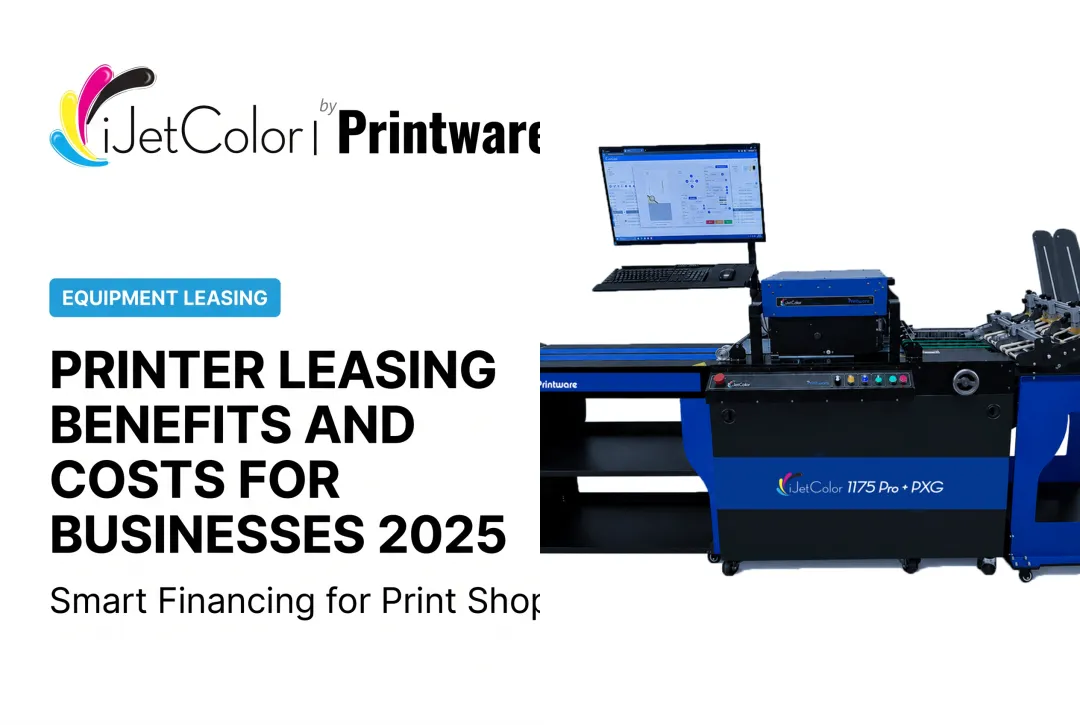
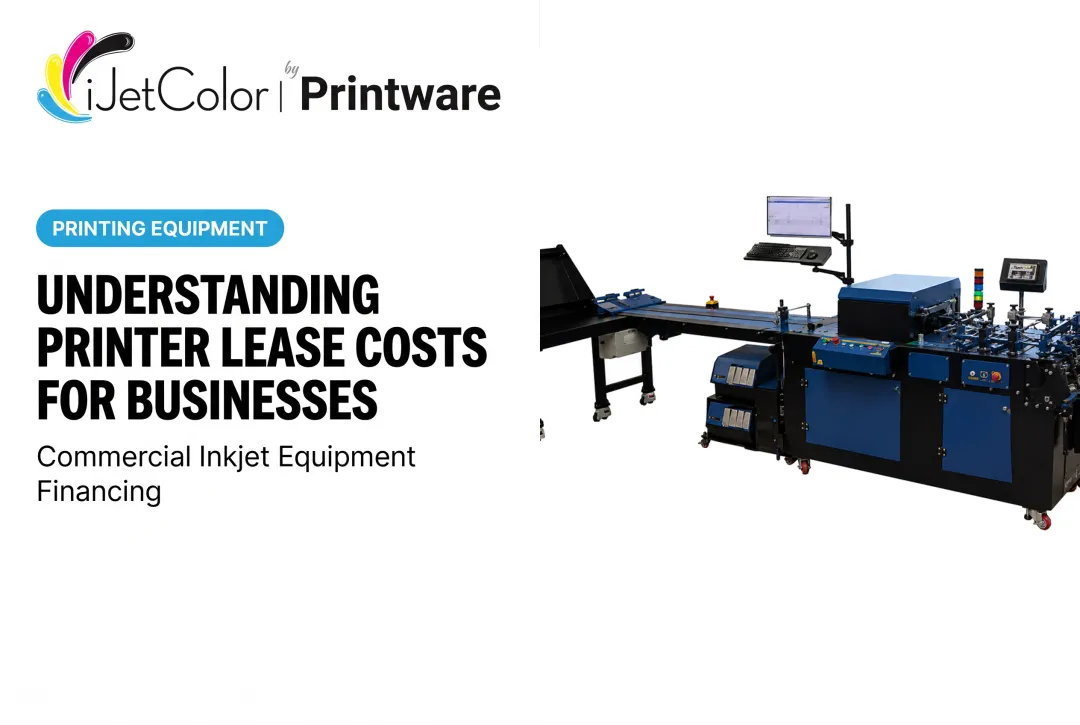
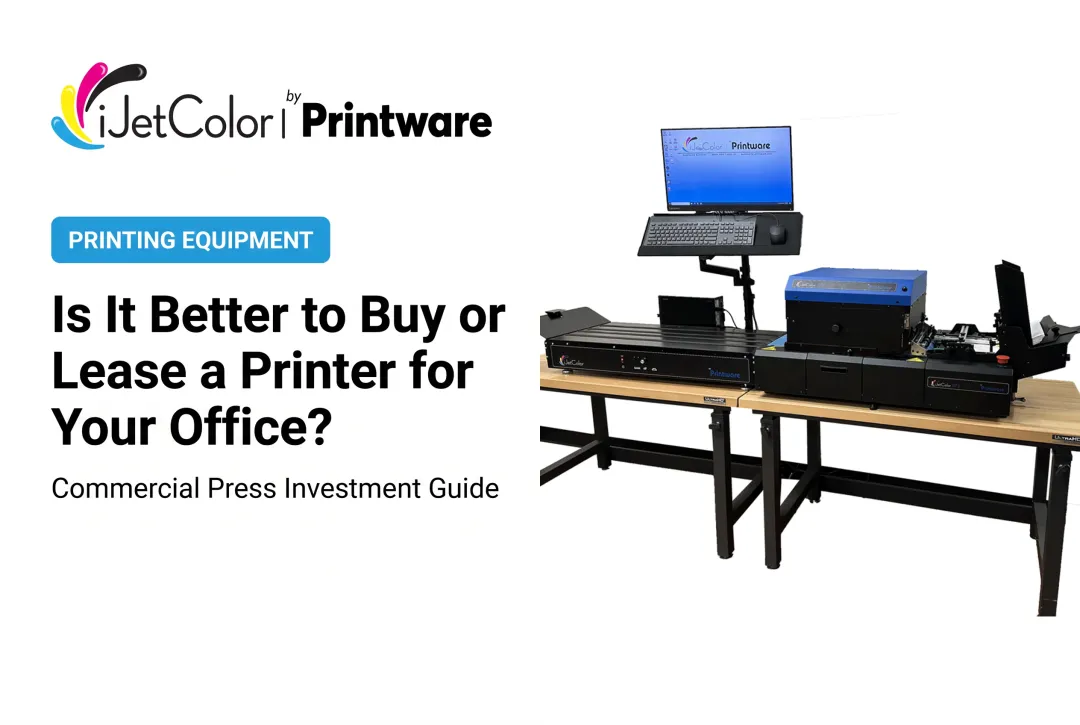
That decision affects more than your monthly budget. It shapes your cash flow, your tax filings, and how fast you actually see a return. Many shops struggle with this exact tradeoff: preserve capital now, or invest for lower costs later?
The math has shifted recently, too. High-speed inkjet presses are faster and more profitable for short-run envelope production than offset, outsourcing, or toner, which changes the leasing-versus-buying calculation in ways it hasn't for years.
TL;DR
- Leasing preserves cash and often bundles maintenance, but usually costs more over the equipment's life
- Buying takes more capital upfront, builds equity, and puts the throughput of a high-volume inkjet press entirely under your control
- Compare on upfront cost, tax treatment (Section 179 vs. lease deduction), flexibility, and total cost of ownership
- Pick by production volume, growth plans, and the total cost of running the press
Leasing vs. Buying Printing Equipment: Quick Comparison
| Factor | Leasing | Buying |
|---|---|---|
| Upfront cost | Low or no down payment | Full purchase price upfront |
| Monthly cash flow | Fixed, predictable payment | No ongoing payment once paid off |
| Total cost over time | Typically higher (financing costs) | Typically lower once paid off |
| Tax treatment | Payments often deductible as OpEx | Depreciation or Section 179 deduction |
| Flexibility | Easier to refresh equipment | Full control, but equipment ages with you |
The tax row above hinges on how the IRS classifies the deal. Rent is generally deductible when you pay to use equipment you don't own. If your "lease" is actually a conditional sales contract, those payments aren't deductible as rent at all—a distinction that changes how you should structure the agreement.

What Is Leasing Printing Equipment?
Leasing is a contractual agreement to use equipment for a fixed term and monthly payment, without taking ownership. For shops managing tight capital, that's the entire appeal: you get production capacity without draining your cash reserves.
Core benefits of leasing:
- Preserves working capital for payroll, ink, paper, and growth
- Often bundles maintenance into the payment structure
- Reduces obsolescence risk since you can refresh equipment at term end
Leasing isn't one-size-fits-all. Common structures include:
- Fair-market-value (FMV) lease: An operating lease. At term end, you can buy at negotiated market rate or keep leasing at reduced rent.
- $1 buyout lease: Functions more like financed ownership. You get 100% financing with no down payment, and you may be treated as the owner for tax purposes—including depreciation and interest deductions.
- Short-term rentals: Useful for testing a technology before committing.
iJetColor sells its presses manufacturer-direct and works with financing partner Synergy Financial Resources, which offers these structures on the iJetColor lineup. Options include zero payments upfront, 90-day deferred payments, and $1.00 buyout, 10% purchase-upon-termination (PUT), or FMV terms, plus early payoff discounts and no blanket lien on business assets.

Use Cases of Leasing
Leasing tends to make the most sense for:
- Shops testing new production capabilities before committing capital
- Growing operations that want predictable OpEx budgeting rather than a large capital outlay
- Businesses managing seasonal cash flow swings with a fixed monthly payment instead of a lump sum
Industry data supports the same pattern. ELFA's 2025 Survey of Equipment Finance Activity reports a $1.3 trillion equipment-finance market in the US, based on data from 100 ELFA-member companies. Financing equipment use is a mainstream capital strategy for print shops, not a last resort.
What Is Buying Printing Equipment?
Buying means you take full ownership of the press — through a cash purchase or an equipment loan. You hold the title, control how the machine is used, and keep any residual value when you eventually sell or trade it.
Once the purchase or loan is paid off, recurring equipment payments stop. From that point, your ongoing costs are mainly ink, parts, and maintenance.
Core benefits of buying:
- No interest or financing charges stacking up over the equipment’s life
- Full control over maintenance schedules and service providers
- Depreciation-based tax advantages, including Section 179 and bonus depreciation
For 2025, the IRS Section 179 deduction caps at $2,500,000, phasing out once qualifying property exceeds $4,000,000. On top of that, IRS Notice 2026-11 confirms a permanent 100% first-year bonus depreciation for qualifying property placed in service after January 19, 2025 — a strong incentive if you’re buying capital equipment this year.
Use Cases of Buying
Buying tends to fit best when:
- Your volume is stable and predictable, and you plan to run the same press for 5+ years
- You're a high-volume commercial printer, direct mail provider, or in-house corporate print operation looking to bring outsourced work in-house
Bringing work in-house is often where ownership pays off fastest. Greenhaven Printing in Shoreview, Minnesota, moved production inside after adopting an iJetColor envelope press. As Mike LaMotte put it: "We don't have the cost of sending a job out, we don't have to pay another vendor. We can keep it in house, control our turn times, and keep the cost down for our customer."
The throughput math on high-speed inkjet supports this shift toward ownership. A console press such as the HP iJetColor 1175C runs 6,210 to 10,000+ envelopes per hour, and the HP iJetColor 1275 Pro reaches up to 20,000 #10 envelopes per hour — enough capacity to absorb work that used to leave the building. For short-run envelope production, that is faster and more profitable than offset, outsourcing, or toner.

Ownership also doesn’t mean handling maintenance alone. Manufacturer-direct support can cover training, parts, and service — so you keep control of the asset without giving up reliable technical backup.
Leasing vs. Buying: Which Is Better for Your Print Operation?
There's no universal answer here. The right call depends on five factors:
- Available capital — Can you absorb the upfront cost without straining operations?
- Production volume stability — Steady, predictable work favors ownership; fluctuating demand favors leasing
- Growth trajectory — Fast-scaling shops may want the flexibility to refresh equipment
- Tax strategy — Section 179 and bonus depreciation change the math for purchases
- Payback speed — How fast can the equipment earn back its cost?
Choose leasing if: preserving cash flow and staying current on technology matter more than long-term cost.
Choose buying if: you have capital available, expect stable volume for years, and want to maximize long-term ROI.
A Wolters Kluwer case study illustrates why total cost of ownership matters more than sticker price. Using $50,000 equipment over eight years, financed purchase, and leasing scenarios, it found current-dollar costs of $32,204 for purchasing versus $34,838 for leasing — a real gap, even before factoring in service and downtime.
That's why TCO (acquisition, service, supplies, and downtime combined) should drive your decision, not the upfront number alone.
Ownership looks riskier when service is uncertain. A manufacturer-direct support model closes that gap. iJetColor's MFG Direct Support, delivered through its iJetAdvantage agreement, includes:
- 24/7 phone technical support at no charge
- Remote web diagnostics and firmware upgrades
- Free replacement of defective non-wearable parts
- Discounted ink, consumables, and wearable parts
- Next-day availability of printheads and spare parts
Support that would otherwise run $150 per hour per incident is folded into the agreement. For shops that want to buy but still need responsive service, that offset matters.

Conclusion
There's no single right answer between leasing and buying printing equipment. It comes down to your cash flow priorities, how stable your volume is, and how quickly the equipment will pay for itself. Short-run inkjet technology is increasingly tilting that math toward ownership for shops with steady daily volume. For short-run envelope production, an in-house inkjet press is faster and more profitable than offset, outsourcing, or toner.
Whichever path you choose, the goal stays the same: faster production and better margins on every job that runs through the press.
Frequently Asked Questions
How does printer leasing work?
You make fixed monthly payments to use equipment the financing company owns for a set term, often with maintenance bundled in. Ownership does not transfer unless the agreement includes a lease-to-own structure.
Is leasing or buying cheaper for printing equipment?
Leasing typically has a lower upfront cost but a higher total cost over time. Buying costs more initially but is usually cheaper long-term once the equipment is paid off.
Can I buy printing equipment at the end of a lease?
Many leases include buyout options, such as a $1 buyout or a fair-market-value purchase, depending on how the lease is structured.
What tax benefits come with buying printing equipment?
Ownership can qualify for Section 179 deductions and depreciation, including 100% bonus depreciation on qualifying property. Lease payments, by contrast, are often deductible as an operating expense.
How long does it take to pay back the cost of a new printing press?
Payback depends heavily on volume and efficiency gains. High-speed inkjet presses running consistent daily orders are faster and more profitable than offset, outsourcing, or toner for short-run envelope work, so the more volume you bring in-house, the sooner the press earns back its cost.
What factors should influence a print shop's lease-or-buy decision?
Weigh cash flow, production volume stability, growth plans, and tax strategy. Compare total cost of ownership over the equipment's useful life, not just the upfront price.